


Europe’s Exporters Pause at the Window as Tariff Instability deepens
- Export market softens as depot congestion and weak container demand pressure
prices - Domestic container demand fairly strong but rising competition limits pricing power24
February 2026, Italy: Transatlantic trade is becoming a game of ‘wait and watch’ for
Italian exporters as, President Donald Trump introduced a new ‘global’ tariff, setting it at
15% for up to 150 days (as of 24 th Feb, 9 AM CET).
Sogese, a European container provider with direct visibility into equipment utilisation and
container demand flows, highlighted that the immediate impact is not a collapse in volumes,
but a clear hesitation in shipment commitments across Europe–U.S. trade lanes.
According to Sogese, exporters are not cancelling cargo, they are pausing decisions,
shortening planning cycles, and adjusting shipment timing as they await clarity, introducing
volatility into container demand patterns rather than structural contraction.
“We are observing hesitation in the market. When trade policy changes this quickly,
exporters prefer to look and wait at the window rather than accelerate commitments.
Across Europe, and particularly in Italy, this is translating into irregular booking patterns and
more tactical shipment planning, rather than an immediate decline in volumes. Stability and
predictability remain essential for exporters to plan with confidence.” Shared Andrea
Monti, CEO, Sogese.
Historically, U.S. tariffs on most EU goods operated under WTO “Most Favoured Nation”
(MFN) rates. Average applied U.S. tariff on EU goods was ~1–3%, and the trade environment
was relatively stable and rules-based. Between 2018-2020, there were selective, sector-
specific tariffs, which were suspended and reinstated sporadically, which created
uncertainties for exporters. In 2025, tariffs expanded under the International Emergency
Economic Powers Act (IEEPA). Many EU (including Italian) goods subject to elevated tariff
rates, commonly around 15% in structured agreements or imposed programs.
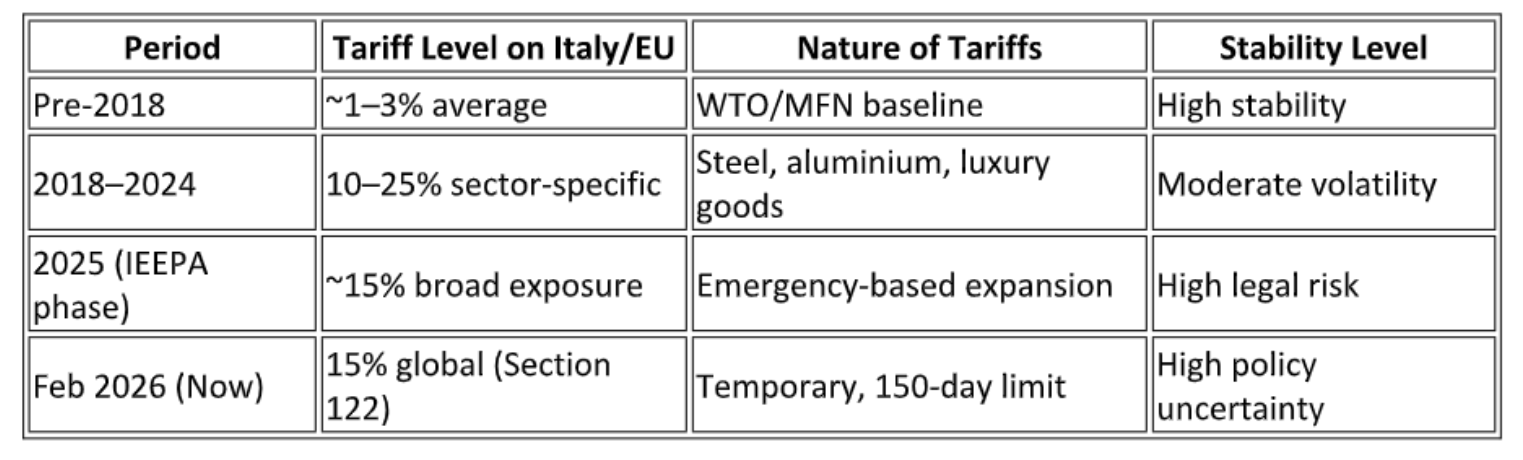
The U.S. remained Italy’s largest bilateral trade surplus market in 2025.
Italy (and the EU) now face a flat 15 % U.S. tariff, which for many products is higher than the rates they were paying before the Supreme Court ruling.
“Italian firms are watching both U.S. legal processes and EU diplomatic action. The related
uncertainties on refunds, tariff regimes, and the EU-U.S. deal will influence booking
behaviour, sourcing strategies, and forward planning in the longer term. Beyond 2026, if
Congress extends the Section 122 tariff, or if new targeted tariffs are added under other
authorities (e.g., Section 301), Italy could face layered tariff exposures.” Shared Monti.
“Orders are not collapsing, but exporter confidence and planning rhythms are definitely
affected.” Concluded Monti.
Market Signals from Italy’s Container Segment According to Sogese’s latest market observations:
Export-facing container demand remains soft.
Weak booking momentum, combined with depot congestion and limited yard space
availability, is placing downward pressure on asset pricing. As a result, lease rates for
export-oriented containers are currently trading at the lower end of the pricing band.
In contrast, domestic container demand within Italy remains comparatively resilient. While
activity levels are stable to strong, increasing competition is limiting upward pricing
movement. Lease rates in the domestic segment remain steady but show limited margin
expansion.
About Sogese
Founded in 1980 as a maritime container repair terminal, Sogese S.r.l. has evolved into one
of Italy’s established players in container sale, leasing, and maintenance. With over 40 years
of operational experience, the company provides dry and refrigerated container solutions
across domestic and international markets. Following its merger with Coremas Polaris in
2025 and the launch of a new logistics hub in Taranto, Sogese now operates a commercial
and logistics network spanning the length of Italy. Its direct exposure to equipment
utilisation, depot activity, and asset pricing dynamics enables Sogese to offer grounded
market insights into container demand and trade flows.
